21/07/2025
Yen Tu-Vinh Nghiem-Con Son, Kiep Bac Complex officially inscribed on the list of UNESCO World Heritage Sites
On July 12, 2025, at the 47th session of the UNESCO World Heritage Committee held in Paris (France), the Yen Tu – Vinh Nghiem – Con Son, Kiep Bac Complex (spanning Quang Ninh and Bac Ninh provinces and Hai Phong city) was officially recognized as a World Cultural Heritage site. This marks Vietnam’s ninth UNESCO World Heritage site and the country’s second trans-provincial heritage site, alongside Ha Long Bay – Cat Ba Archipelago (located in Quang Ninh province and Hai Phong city).
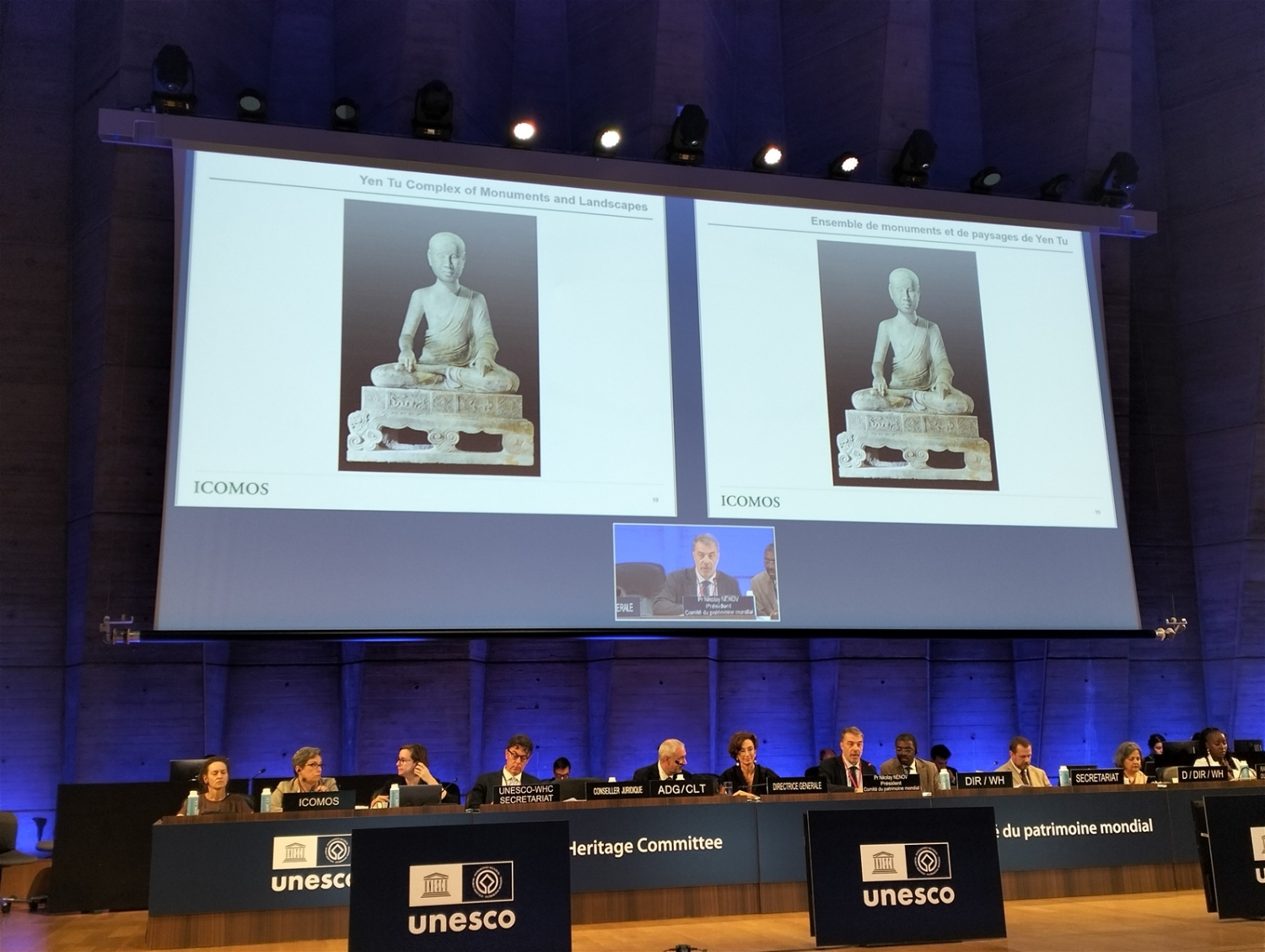 Discussion Session on Appication Dossier for the Yen Tu – Vinh Nghiem – Con Son, Kiep Bac Complex as a World Heritage Site
(Source: Department of Cultural Heritage)
Amidst a jubilant atmosphere at the session, UNESCO member state leaders and experts warmly congratulated the Vietnamese delegation on the inscription of the Yen Tu – Vinh Nghiem – Con Son, Kiep Bac Complex as a World Cultural Heritage site.
The Yen Tu – Vinh Nghiem - Con Son, Kiep Bac Complex, with Truc Lam Buddhism is the heart, was established in the 13th century under the Tran dynasty, notably under the influence of King-Monk Tran Nhan Tong. Truc Lam Buddhism brought about profound cultural and spiritual values that have made lasting contributions to humanity’s cultural heritage. Originating from the sacred mountains of Yen Tu, Truc Lam Buddhism represents a philosophical system of tolerance, compassion, and altruism. It reflects a harmonious synthesis of Mahayana Buddhism, Confucian ethics, Taoist cosmology, and indigenous Vietnamese beliefs. These philosophical and cultural values align closely with UNESCO’s core missions in education, developing a culture of peace, fostering autonomy, encouraging harmony between humanity and nature, and respecting nature.
Through its system of temples, shrines, pilgrimage routes, steles, ancient texts, and well-preserved relics from from Yen Tu to Vinh Nghiem and Con Son – Kiep Bac, the heritage complex vividly illustrates the evolution of Truc Lam Buddhism: from its formation a institutionalization, revival, and continued transmission of profound humnanistic values. The historical sites, shaped over centuries, are not only rich in history, architecture, and art but also serve as religious centers and spiritual pilgrimage destinations for millions of pilgrims and visitors annually.
The inscription of the Yen Tu – Vinh Nghiem – Con Son, Kiep Bac Complex as a UNESCO World Cultural Heritage site stands as a testament to the unique convergence of State, Religion, and People in shaping Vietnam’s cultural identity. It is also a vivid representation of a sacred landscape created through deep interaction between humans and nature, nurturing an ethical system based on love for peace, compassion, self-cultivation, and a spirit of harmony with the universe.
 Bronze Pagoda on the top of Yen Tu mountain (Application Dossier for World Heritage Site).
Vietnam’s World Heritage sites recognized by UNESCO not only help preserve the country’s exceptional cultural and natural values but also play an important role in promoting local socio-economic development, environmental protection, green growth, and sustainable development. Furthermore, their inscription contributes to promoting the image of Vietnam to the world, enriching the shared cultural treasury of humanity.
Source: N.T.M.C