Non nuoc Cao Bang Geopark takes visitors to majestic landscapes while opening a journey back in time to experience the cultural depth of a land rich in identity, where humans live in harmony with natura to create a vivid heritage story.
 Traditional culture present in every stilt house.
The journey to explore Non nuoc Cao Bang Geopark is an emotional dialogue with nature, history, and local culture, where every stone and stream whispers stories of origins. The highlight that makes this journey unique is the strong cultural values present in every stilt house, through the tune of the Tinh lute, the sweet melodies of the Then songs, and the daily life steeped in the identity of borderland residents.
In particular, on the eastern tourism route of Non nuoc Cao Bang Geopark, “Experience indigenous cultures in a wonderland”, visitors have the opportunity to stop at traditional craft villages – “living museums” that preserve cultural values passed down over generations. By flickering fire, and rhythmic weaving looms, skillful hands tirelessly continue weaving, making incense, or crafting traditional paper. Each product is not just for daily use but a crystallization of communal memory, a living testament to a culture preserved with love and pride.
In Dia Tren Village (Quang Uyen Commune), traditional paper-making has been maintained for generations, closely tied to folk beliefs and the spiritual rituals of the Nung An people. The entire process is totally manual, from selecting materials, pounding, filtering the pulp, to drying the paper, demonstrating the villagers’ meticulousness, patience, and the dedication to preserving cultural identity. Nearby, in Phja Thap incense Village (Quang Uyen Commune) - one of the provincial traditional craft villages with over 100 years of history – the artisanal making of incense from natural herbs such as cinnamonm gleditsia fruit, and bau hat (a native tree) has been preserved. Though simple in appearance, the brown incense bundles carry the pure, rustic fragrance of the mountains and forest. In the peaceful space under stilt houses, Nung An women diligently roll each incense stick, continuing an age-old custom and way of life passed down from ancestors. In Pac Rang blacksmithing Village (Quang Uyen Commune), the daily clanging of hammers and flickering forges sustain the rhythm of a longstanding traditional craft. In 2019, the blacksmithing of the Nung An people in Phuc Sen Commune was recognized as a National Intangible Cultural Heritage. From basic forges, locals create sharp, durable farming tools renowned throughout the region, attracting traders from afar. These products not only serve farming but also embody the essence of a traditional craft preserved through generations.
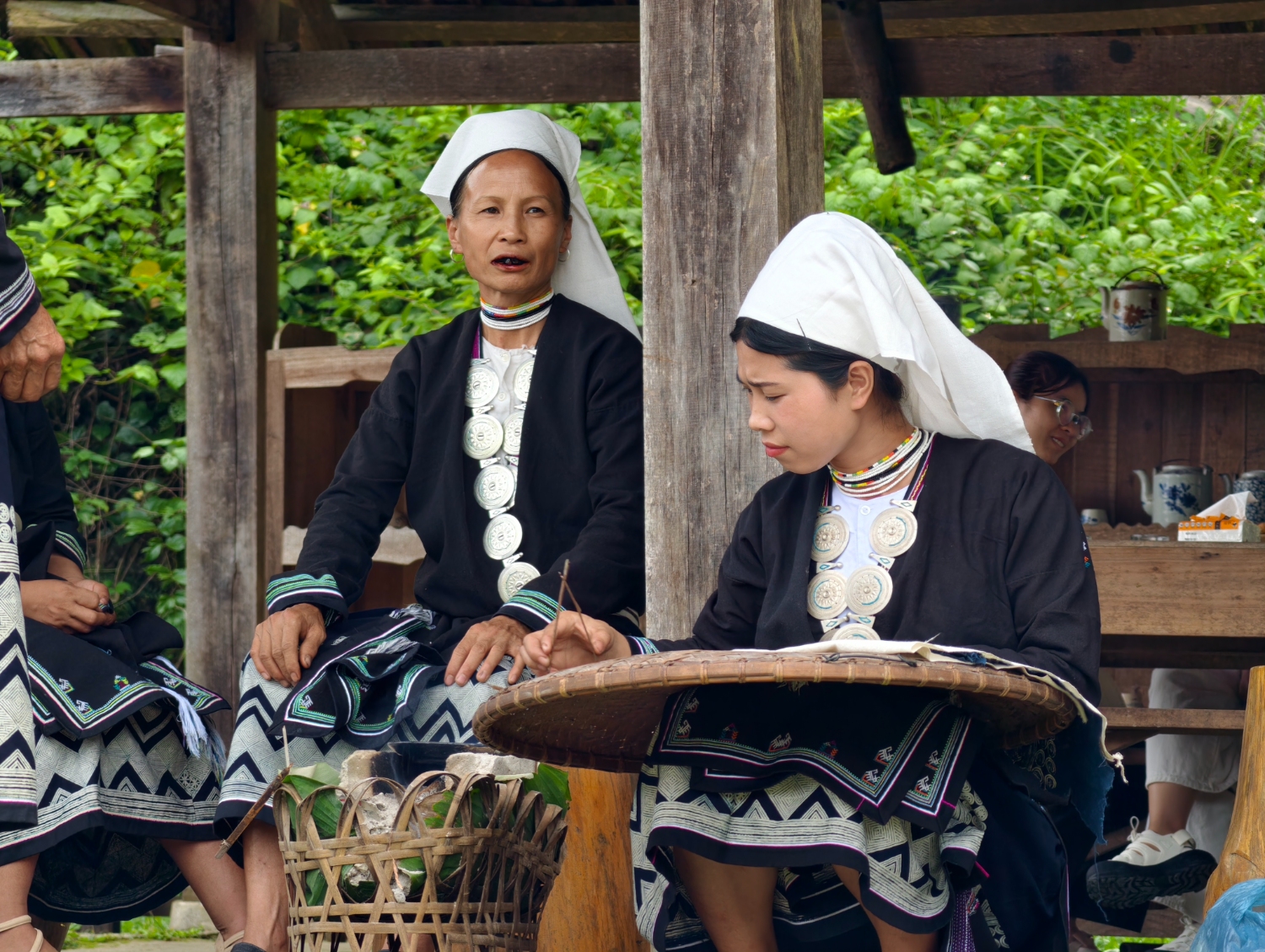 The art of printing patterns on fabric with beeswax of the Dao Tien in Hoai Khao Village (Thanh Cong Commune).
Today, Non nuoc Cao Bang Geopark continues to tell the story of this wonderful land, where cultural heritage is not buried in the past but becomes a foundation for sustainable development in the present and future. In this journey, the active participation of the local community is a key factor in giving long-lasting vitality to the region. Local people have become creators of typical tourism products, confidently sharing their stories and homeland. A notable example is Dam Thuy Commune, where Khuoi Ky Tay ethnic community-based tourism village is gradually flourishing through a harmonious combination of natural landscapes and cultural identity. Located within the Ban Gioc Waterfall Tourism Area, Khuoi Ky is an ancient village hundreds of years old, spanning about 10,000 m², nestled beside a clear and tranquil brook. Despite the passage of time, the unique stone stilt houses have been preserved intact, maintaining traditional customs and an ancient, serene beauty, like a vivid memory amid the borderland mountains. Locals not only run tourism activities but also tell stories through their homes, traditional meals, and by their treat to tourists as family members.
Tobi Hofmann, a German tourist, shared: “Visiting Khuoi Ky Village, I was truly impressed to immerse myself in the daily life of the local people through culturally rich experiences such as trying traditional clothing, learning to make banh khao (a kind of rice cake), weaving straw mats, and participating in local cultural performances. These experiences allowed me to get a deeper understanding of the culture, people, and genuine hospitality of this land.”
Exploring Non nuoc Cao Bang Geopark is not only strolling through magnificent landscapes but also a journey that touches the cultural values continued daily within community life. In this way, the “wonderland” is not only written in books or distant memories but presents like a quiet stream flowing through every house and every sound of life, nurturing and stirring the emotions of anyone who has ever visited this land.
Author: Mai Chi