Science Talk - UNESCO designated sites & International biodiversity and climate frameworks: From commitments to actions
On August 6, UNESCO Office in Vietnam organized a science talk “UNESCO designated sites & International biodiversity and climate frameworks: From commitments to actions”.
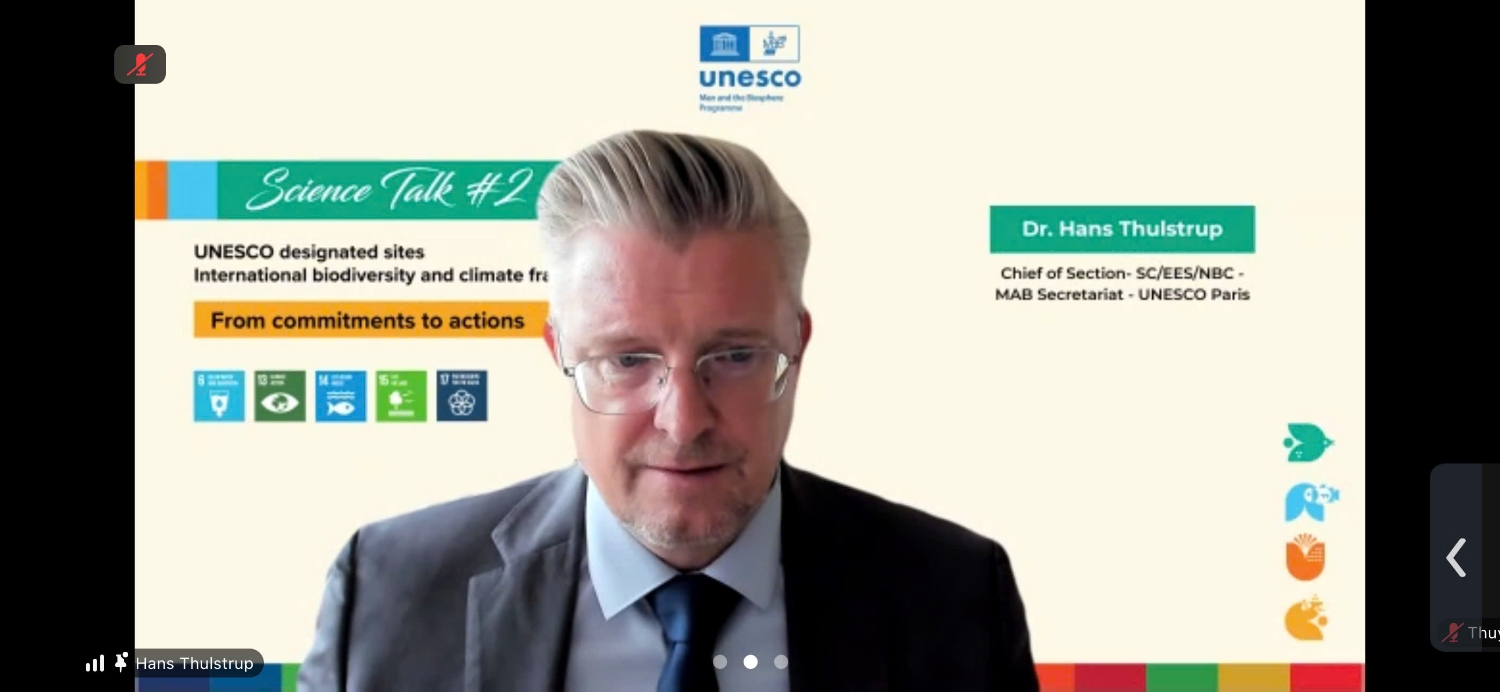 Dr. Hans Thulstrup, Chief of Section -SC/EEC/NBC -MAB Secretariat - UNESCO Paris presented the Hangzhou MAB Strategic Action Plan 2026–2035.
The talk was held within the framework of the Man and the Biosphere (MAB) Programme, aiming to strengthen capacity and the sustainable management of Biosphere Reserves (BRs) and UNESCO Global Geoparks (UGGps) through the sharing of international experience and the integration of global frameworks into local practices.
Attending the talk were international and domestic experts, including Dr. Hans Thulstrup – Chief of the Section on Ecological and Earth Science, MAB Networking: Biosphere Reserves and Capacity Building, UNESCO Paris; DSc. Hiroyuki Matsuda – Chairman of Earthwatch Japan; representatives from the Department of Climate Change, Nature and Biodiversity Conservation Agency (Ministry of Agriculture and Environment); as well as representatives from Biosphere Reserves and UNESCO Global Geoparks in Vietnam.
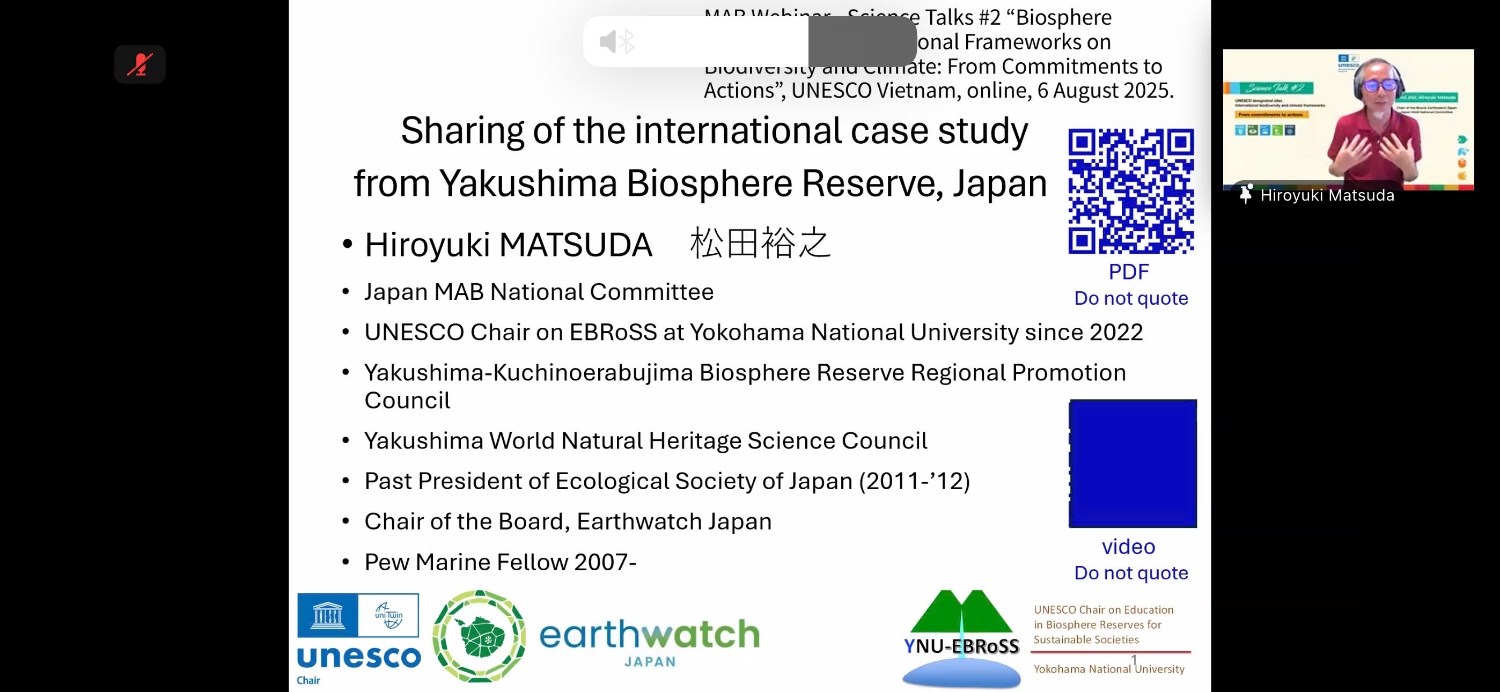 DSc. Hiroyuki Matsuda – Chairman of Earthwatch Japan shared practices from Yakushima Biophere Reserve and World Natural Heritage Site (Japan).
The Science Talk aims to bridge the gap between global commitments and local implementation by updating participants on key international agreements on climate and biodiversity, and sharing global best practices in integrating these frameworks into management strategies: the 2026-2035 MAB Strategy and Action Plan, the Paris Agreement on Climate Change, Vietnam’s climate and biodiversity commitments; the Kunming–Montreal Global Biodiversity Framework and the National Biodiversity Strategy and Action Plan to 2030, vision to 2050: Key objectives and their significance for Biosphere Reserves.
To address the increasingly severe challenges of climate change, the international community has come together to negotiate and sign global agreements and commitments aimed at minimizing negative impacts on ecosystems and human life. At the Conference of the Parties (COP26) of the UN Framework Convention on Climate Change (UK, 2021), Viet Nam, along with nearly 150 other countries, committed to achieving net-zero emissions by 2050. At COP27 (Egypt, 2022) and COP28 (UAE, 2023), Viet Nam reaffirmed its determination and announced its JETP Resource Mobilization Plan with international partners, including the European Union, the United Kingdom of Great Britain and Northern Ireland, the United States, Japan, Germany, France, Italy, Canada, Denmark, and Norway. Under the National Climate Change Strategy to 2050, Viet Nam has set the target of reducing greenhouse gas emissions by 43.5% by 2030 compared to the business-as-usual (BAU) scenario, and achieving net-zero emissions by 2050. For the energy sector specifically, the goal is to reduce emissions by 91.6%, not exceeding 101 million tonnes of CO₂ equivalent. These commitments and actions demonstrate Viet Nam’s strong determination in the fight against climate change, opening up opportunities to tap into the global shift of financial resources towards low-emission development, while fostering cooperation to promote a circular economy and effectively adapt to climate change.
 Non Nuoc Cao Bang UGGp is rich in biodiversity, boasting a wide range of ecosystems and many endemic fauna and flora species.
With the goal of promoting global biodiversity conservation, at COP15 (Canada, 2022), the parties adopted the Kunming–Montreal Global Biodiversity Framework, setting targets for 2030 and a vision to 2050. As one of the 16 most biodiverse countries in the world, Viet Nam is facing serious challenges such as ecosystem degradation, environmental pollution, and the growing impacts of climate change. This underscores the urgent need to raise awareness, conserve nature, manage resources sustainably, and ensure harmony between people and nature. The National Biodiversity Strategy 2030, vision 2050, approved by the Prime Minister, reflects Viet Nam’s clear commitment to fulfilling global commitments and its determination to conserve natural values.
During the science talk, speakers shared international experiences in implementing effective strategies for integrating global frameworks into the management of Biosphere Reserves and UNESCO Global Geoparks. They also discussed solutions for biodiversity conservation, climate change adaptation, and resource mobilization to support BRs in assessing the local impacts of climate change. These topics were illustrated through practical insights from the Yakushima Biosphere Reserve and World Natural Heritage Site in Japan; a discussion on integrating climate and biodiversity goals into the management plans of UNESCO designated sites (BRs, UGGps, and World Heritage Sites); as well as orientations for developing the network of BRs in Viet Nam in the coming time.
Through contributions from international and domestic agencies and experts, the science talk provided practical guidance to support BRs and UGGps in developing, updating, and integrating relevant programs and activities into their Management Plans, ensuring alignment with national policies and Viet Nam’s global commitments. In particular, these guidelines will help prepare for the implementation of the Hangzhou Strategic Action Plan for UNESCO’s Man and the Biosphere (MAB) Programme and its World Network of Biosphere Reserves, which is expected to be adopted at the MAB Congress to be held in Hangzhou, China, in September 2025.
Source: L.T