Exploring the Eastern Route – “Experience Traditional Culture in a Wonderland”
The Eastern
Route – “Experience Traditional Culture in a Wonderland” in the
Non Nuoc Cao Bang UNESCO Global Geopark takes visitors on a journey back
through time to discover a remarkable interplay between spectacular natural
landscapes and the rich traditional cultural heritage of local communities.
Following National Highway 3
eastward, the landscape gradually unfolds like a living ink-wash painting, with
towering limestone mountains, lush green rice fields, and peaceful villages
nestled at the foot of the mountains. As the journey continues deeper into the
region, visitors can increasingly appreciate the pristine and tranquil beauty
of a land shaped by hundreds of millions of years of geological history.
Together, these elements create a harmonious blend of nature and cultural
traditions in this northern frontier region.
The journey begins at the Ma
Phuc Pass (Tra Linh Commune), one of the most scenic mountain passes in Cao
Bang. Stretching for more than 3.5 kilometres at an elevation of around 700
metres above sea level, Ma Phuc Pass winds through seven steep sections between
two towering limestone mountain ranges. Approximately 260 million years ago,
numerous volcanoes were active beneath the sea in this area. Lava erupted
underwater and cooled rapidly, forming stacked pillow lavas that provide
evidence of intense tectonic activity during the geological history of the
Earth. Ma Phuc Pass is also associated with an intangible cultural heritage
story dating back to the 11th century. According to local legend, during a
border patrol, the Tay–Nung leader Nung Tri Cao encountered this rugged pass.
His horse knelt down and could go no farther, giving rise to the name “Ma
Phuc”, meaning “kneeling horse”.

Continuing along the Eastern
Route, visitors arrive at Mountain Angel Eye (Tra Linh Commune), one of the
outstanding geosites of Non Nuoc Cao Bang UNESCO Global Geopark, with
internationally significant geological value. Mountain Angel Eye is in fact a
circular natural window, more than 50 metres in diameter and situated
approximately 50 metres above the lake. It was formed as a result of uplift
during the Neogene–Quaternary tectonic evolution, which significantly reshaped
the limestone landscape. The opening developed within tower-karst terrain at a
general elevation of around 650–700 metres. During the rainy season, the lake
rises and its calm surface reflects the surrounding mountains, creating a
picturesque landscape. In the dry season, the water recedes, revealing a lush
carpet of grass stretching across the valley like a highland grassland amid the
mountains. This combination of pristine and dramatic scenery makes Mountain
Angel Eye an especially captivating stop on the journey through the northern
frontier.
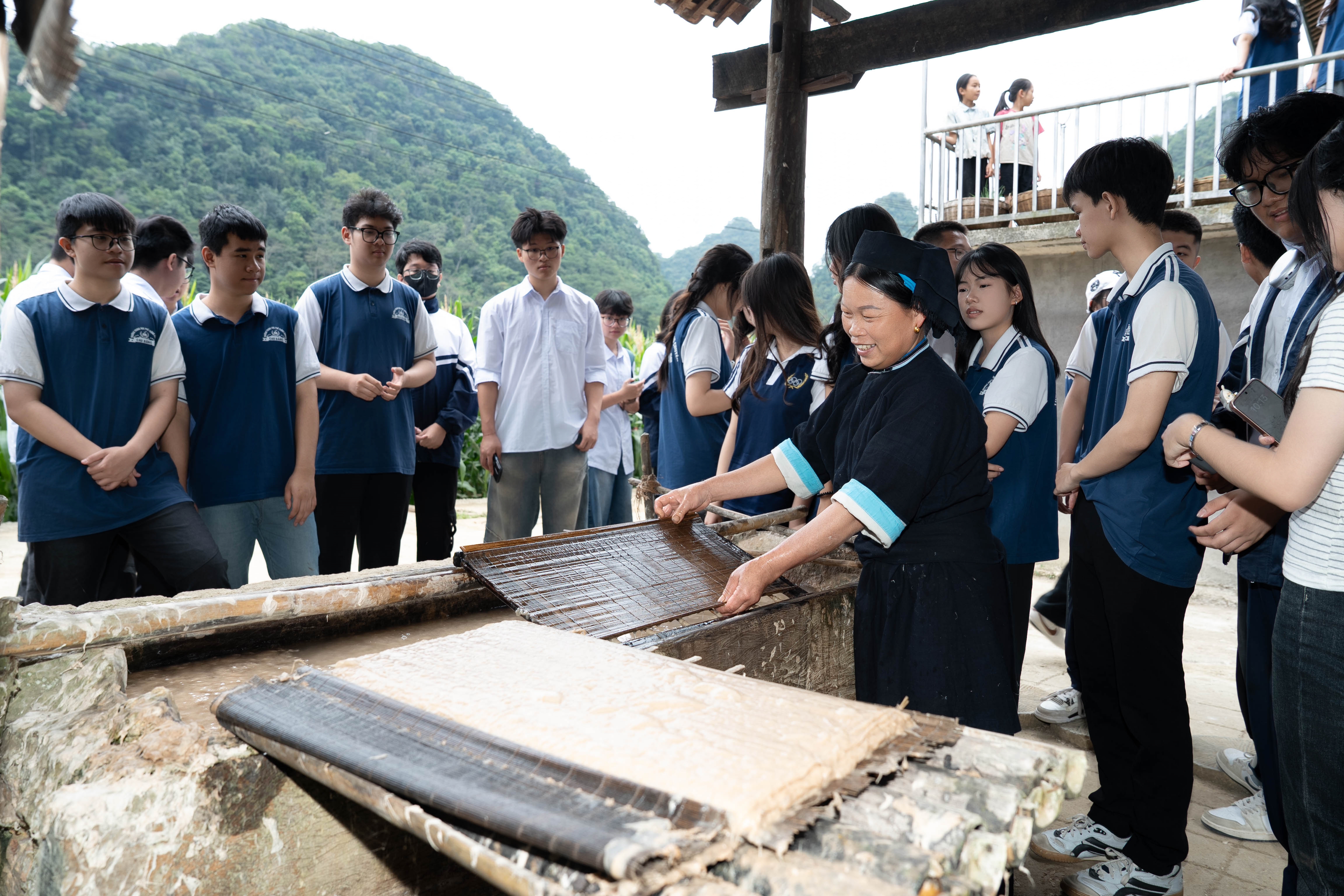
Along the Eastern Route,
visitors have opportunities to explore traditional craft villages where local
communities continue to preserve and promote cultural values passed down
through generations. At Dia Tren Village (Quang Uyen Commune), the traditional
making of Do paper has been maintained for generations and remains closely
associated with the folk beliefs and spiritual rituals of the Nung An people.
The entire process is carried out by hand, from selecting raw materials and
pounding them to pulping, filtering, and drying the paper. Each stage reflects
the care, patience, and commitment of the local community to safeguarding its
cultural identity.
The journey continues to Phja
Thap Incense Village (Quang Uyen Commune), one of the province’s officially
recognized traditional craft villages, with a history of more than 100 years.
Incense in Phja Thap is made entirely from natural herbs and plant materials
such as cinnamon, Gleditsia australis, and bau hat, producing a gentle
fragrance that carries the fresh essence of the mountain forests and permeates
the atmosphere of this northern frontier village. Visitors can often see Nung
An women gathered on the verandas of traditional stilt houses, skilfully
rolling and shaping incense sticks by hand. Every stage is carefully undertaken
with dexterity and respect, as though each person were continuing a way of life
and an age-old custom passed down from their ancestors.
Particularly distinctive is
Pac Rang forging Village (Quang Uyen Commune), where the rhythmic sound of
hammers and the glow of traditional forges continue to bring this
long-established craft to life. In 2019, the blacksmithing craft of the Nung An
people in Phuc Sen Commune was inscribed on the National Intangible Cultural
Heritage List. Using simple forges and skilled hands, local craftspeople
produce sharp and durable agricultural tools that are well known throughout the
region and sought after by traders from many places. These products serve
practical needs while embodying the craftsmanship and accumulated knowledge of
a traditional craft preserved through generations.

These craft villages preserve
not only cultural memories, ethnic languages, and community traditions, but
also vividly reflect the distinctive identity of each locality. Through visits
to these villages, travellers can gain first-hand insights into everyday life,
learn about local customs and traditions, observe traditional production
processes, and experience the living cultural heritage that has been
safeguarded and transmitted from one generation to the next.
Leaving the traditional craft
villages behind, the journey continues to Nguom Ngao Cave (Dam Thuy Commune),
one of the most spectacular caves in the mountainous northern region of
Vietnam. Extending for more than 2,000 metres, the cave contains a fascinating
world of stalactites and stalagmites formed over millions of years, creating
countless imaginative shapes known locally as the Golden Waterfall, Silver
Waterfall, Pillar Supporting the Sky, Upside-down Lotus, Terraced Fields, and
more. Since 2021, the nearly 3-kilometre Ban Thuon adventure route has been
opened to visitors, offering an exciting experience for those seeking
adventure. The route involves climbing rock faces, wading through streams in
darkness, and exploring passages that retain much of their natural and pristine
character.
Located along Provincial Road
206 on the way to Nguom Ngao Cave, Khuoi Ky Stone Village (Dam Thuy Commune) is
a distinctive ancient village within the Ban Gioc Waterfall tourist area.
Established hundreds of years ago and covering an area of approximately 10,000
square metres, the village is renowned for its traditional stone-built stilt
houses. Through the passage of time, the village has retained its traditional
customs and distinctive architectural character, creating an atmosphere of
tranquillity and timelessness amid the expansive mountain landscape of the
border region.
Approximately 4 kilometres
from Nguom Ngao Cave, Ban Gioc Waterfall (Dam Thuy Commune) is regarded as one
of the most beautiful waterfalls in Vietnam. It is also the fourth-largest
waterfall in the world among waterfalls located on international borders and
has been listed among the world’s most spectacular waterfalls. Viewed from a
distance, Ban Gioc waterfall appears majestic, with broad streams of white
water cascading over multiple limestone terraces and creating clouds of spray.
The roar of the waterfall reverberates through the surrounding mountains like
an endless symphony of nature. Visitors can take a bamboo raft close to the
foot of the waterfall to enjoy panoramic views and feel the cool spray of the
water, or experience the cross-border tourism route within the Ban Gioc–Detian
Scenic Area and admire the waterfall from a variety of unique perspectives.
In addition to its major
attractions, the Eastern Route of Non Nuoc Cao Bang UNESCO Global Geopark also
contains numerous lesser-known heritage sites with distinctive geological,
landscape, and cultural values, including Bach Linh Shrine, Magic stone,
traditional wooden wheels, and Thoong Got Landscape. Each stop forms another
piece of the diverse mosaic of nature and culture in the land of Cao Bang.
Throughout the journey, visitors can immerse themselves in memorable cultural
experiences: listening to the soulful melodies of Then singing accompanied by
the tinh lute, and tasting local specialties such as tram sticky rice, roasted
duck, and smoked pork sausage. Together, these experiences create a symphony of
memories and emotions, connecting people with the nature, culture, and heritage
of Cao Bang.
As the exploration of the Eastern Route –
“Experience Traditional Culture in a Wonderland” comes to an end, visitors take with them the lingering impressions
of this northern frontier, where beauty quietly reveals itself through
heritage, culture, and the strength of local communities. Building on these
foundations, the Non Nuoc Cao Bang UNESCO Global Geopark continues to shape a
story of balanced development, where conservation, cultural continuity, and
innovation are nurtured through local knowledge and a deep sense of pride in
the homeland.